
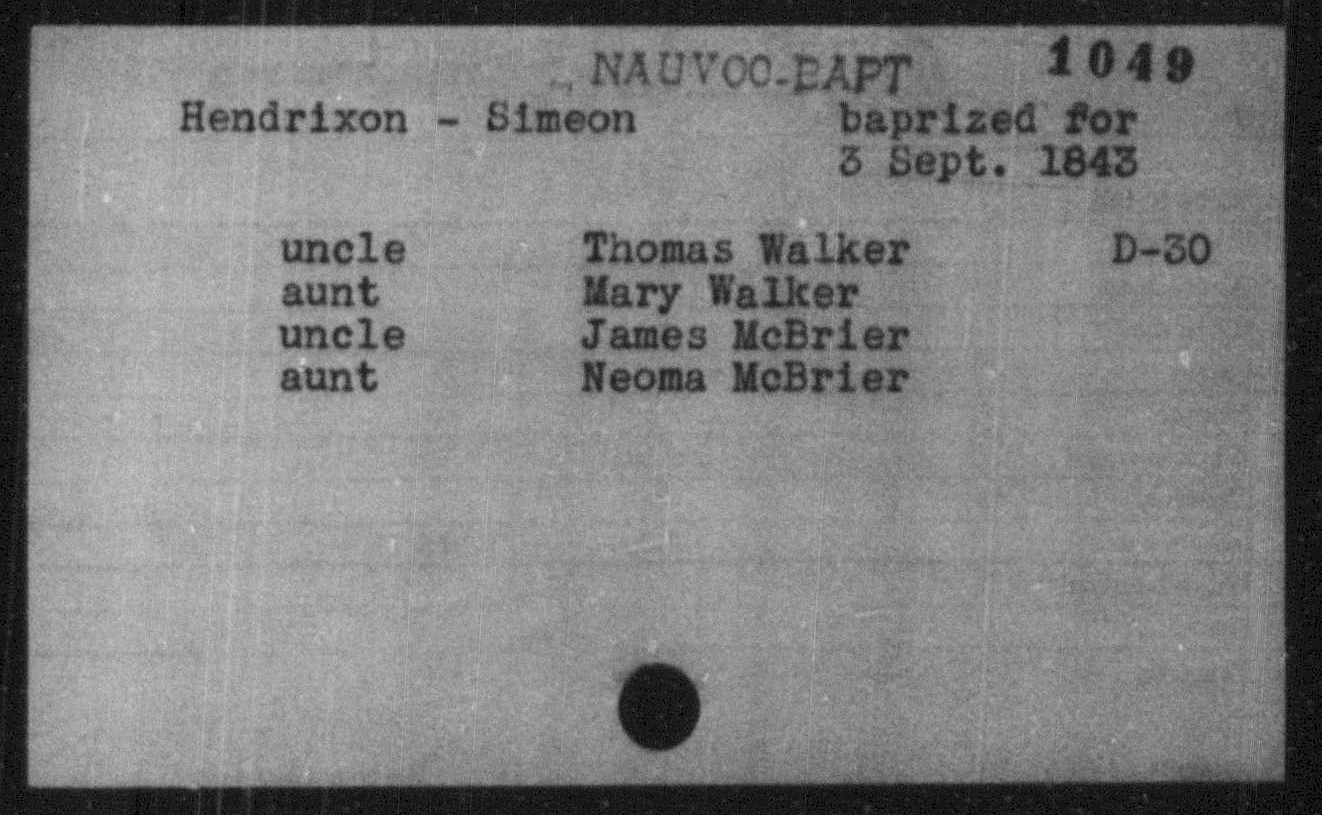
We know Mary Hendrickson is the daughter of John Hendrickson and Eve, because Simeon Hendrickson names her in his LDS/Mormon 1843 Baptisms for the Dead as his aunt, Mary Walker, along with his cousin “Neoma” (Naomi) and Naomi’s husband James “McBrier” (McBrayers).
Naomi is listed as “aunt” on this transcribed card. I don’t have the original hand-written ledger for 1843 (I have it for 1841) but I have seen incorrect transcriptions from the hand-written 1841 ledger to the 1841 cards. The marriage record below shows that Naomi is Mary’s daughter, not her sister. The female line for Mary Hendrickson is also proven through mtDNA — DNA that’s passed mother-to-daughter, from Mary, to her daughter Naomi, and via Naomi to her daughter Elizabeth. I think Mary must have been very young when she had Naomi, and they passed Naomi off as Mary’s younger sister. It’s not until Naomi’s marriage that Mary calls her “daughter.”
Note: Mary Hendrickson is not a daughter-in-law of John and Eve Hendrickson. If that were true, Simeon would have baptized her “Hendrickson” husband at the same time. mtDNA shows Mary is the daughter of Eve.
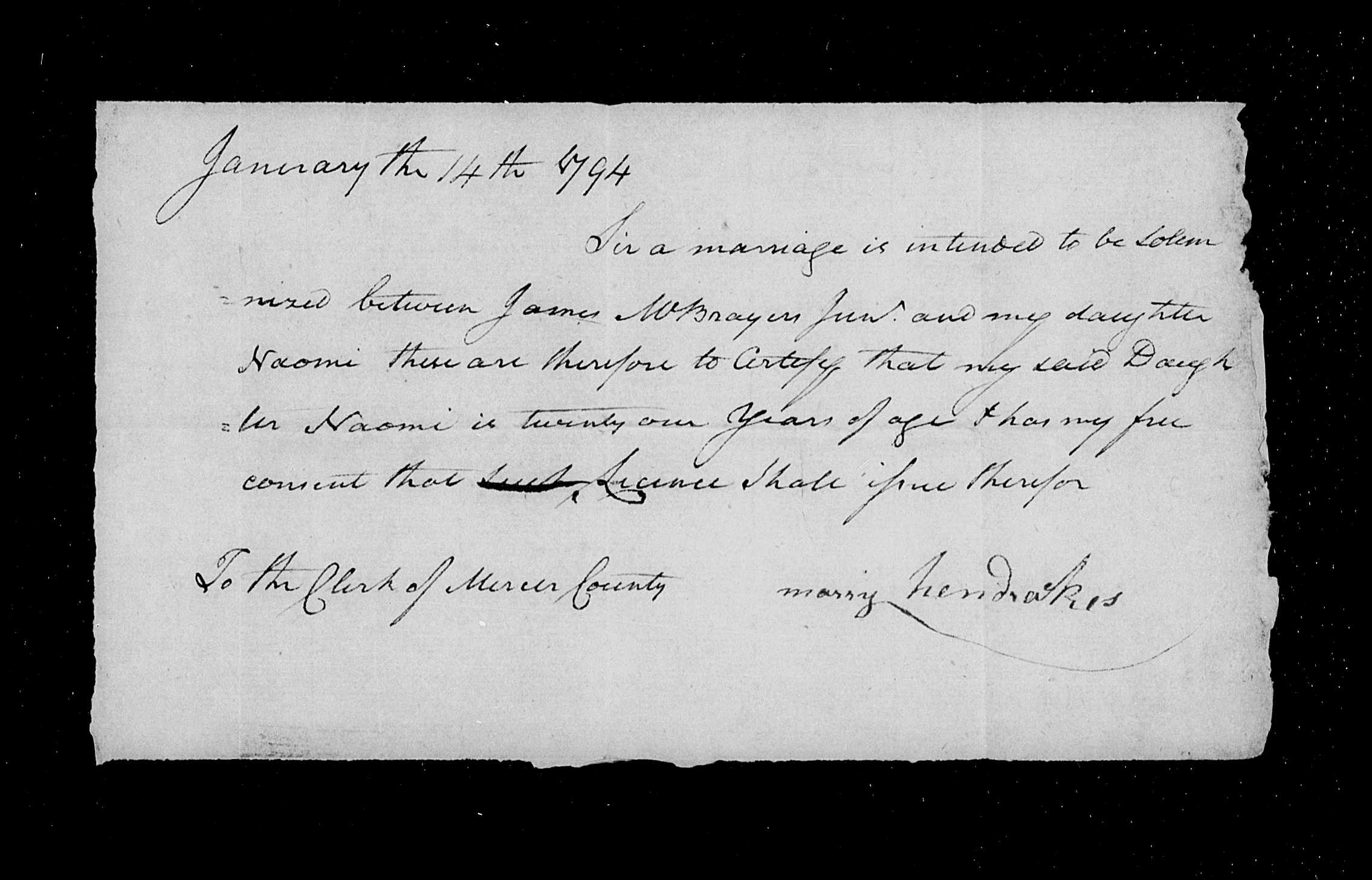
Even though Simeon Hendrickson lists both Mary and Naomi as his aunts, “Mary Hendrakes” gives consent for the marriage of her daughter Naomi to James McBrayers in January of 1794, Mercer County, Kentucky. So, we know Mary is Naomi’s mother.
If Naomi needed consent, then she was under 21, so born after 1773, or looks young enough that the parents’ consent is required. In Naomi’s 1830 census record, it indicates she’s born between 1761-1770. It’s highly likely that Naomi is the offspring of this rape, though we can’t know for sure.
Mary doesn’t marry Thomas Walker until after 1794 because she signs Naomi’s consent as “Mary Hendrakes.”
Details about the rape case
The rape happened in Loudoun County, Virginia, but because it was a felony, the case was heard in Williamsburg, Virginia.
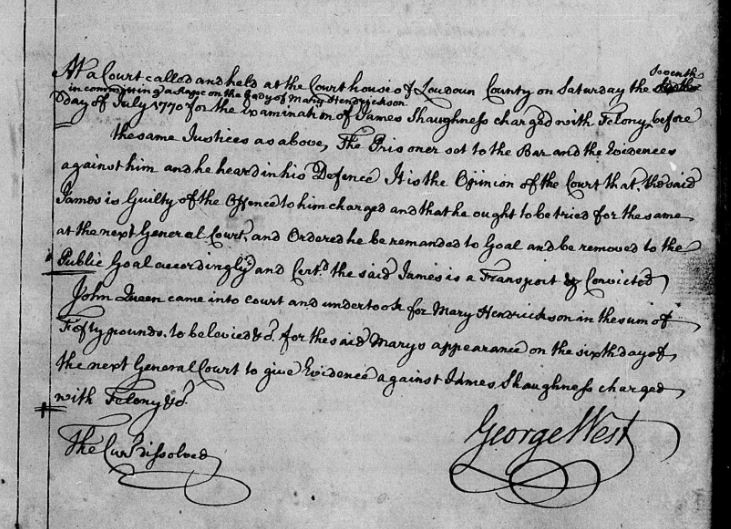
Loudoun County, Virginia, Order Book D, 7 July 1770. It is the ONLY case held on this special session of the court.
At a Court called and held Saturday the 7th of July 1770 for the examination of James Shaughness charged with felony in committing a rape on the body of Mary Hendrickson. Before George West, Craven Peyton, William Douglass, Stephen Donaldson & Fleming Patterson, Gent. Justices. Pleads not thereof guilty. Opinion of the Court that James is guilty of the felony and ought to be tried for the same at the next General Court [in Williamsburg, VA]. Ordered that he be remanded to goal, and sent down for a further tryal and that it be certified that James is a transport and convicted. John Queen acknowledged £50 bond that Mary shall make her personal appearance in City of Williamsburg on the 6th day of the next General Court to give evidence. Court dissolved. George West. Truly recorded by C. Binns. Cl.
Notes and timeline
- In those days, women had to tell about the rape within 40 days of it occurring, because “concealing it implies consent.”
- The rape case came before the Loudoun County court on July 7, 1770, so it had to have occurred sometime in the preceding 40 days. Previous to this, the court met on Saturday, April 7, 1770, then meets for this special July meeting, and then meets again Monday, July 9. 40 days prior to July 7 would have been around late May, so the rape happened sometime between late May and early July 1770.
- I suspect either is happened just before July 7 or the court/sheriff/parish found that she was pregnant or had just had a baby right before July 7. Otherwise, why call a court session to hear just one case? That’s not typically what we see in these pages.
- Because it is a high crimes case (a felony punishable by death, not a civil suit), it is sent to the General Court in Williamsburg.
- John Queen gives bond that Mary Hendrickson will show up in Williamsburg for the court case. The question is: why didn’t John Hendrickson, her father, give a bond? The answer might be in the dates: At this time, John is scouting out new land in the Fayette County, PA area. It was common for men to go to the new farm, clear land, and plant a crop in the Spring, then come back to get their wife and children and take them to the new farm by autumn to harvest the crop. John might not have been in Loudoun, VA at this time, and indeed, there is a record in a history book that says a man named Hendricks got land near Greene County, PA (next to Fayette County, PA) in 1770. There are no other Hendricks/Hendrickson men in the Fayette/Greene area that early except John Hendrickson, and his sons are too young to post bond.
- We need to find out how the Hendrickson family is connected to the Queen or McQueen family of Loudoun. It’s likely to be a family member, or someone close to the family, to post a bond ensuring someone would show up in court. This is likely the John Queen Sr, married to Mary Butler. John’s son, John Jr., would have only been 15 at the time, so it has to be Sr. I know Elijah Queen marries Barbara Hendrickson, Mary’s sister, in 1792, but I can’t find proof of a connection between Elijah and John Queen Sr. John Queen writes a will in 1803 Loudoun, VA and names a son Elijah Queen — BUT, Barbara Hendrickson Queen has already remarried by the late 1790s, so it can’t be the same Elijah Queen if her first husband is dead. Of course, if they are divorced, then it can be the same Elijah Queen. There is an Elijah Queen with an 1820 census records, so for all you Queen researchers out there, here’s another nugget to chew on.
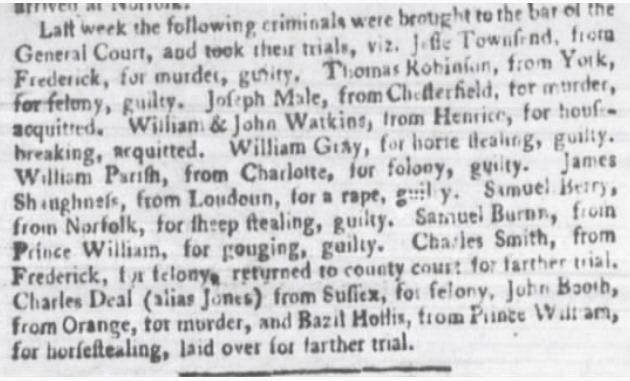
- Because it was a capital punishment case, the case is heard in Williamsburg, the capital of Virginia at the time. The court case is mentioned first in the October 25, 1770 issue of The Virginia Gazette, and says “came to court last week” – so during the week of October 15-19. Shaugness is found guilty and sentenced to death.
- Even though this is a capital case punishable by death, the governor could issue a pardon. However, Governor Botetourt (Norborne Berkeley aka Lord Botetourt) died on October 15, 1770 (keep note of this date, you’ll need it later in the blog post), and the new governor was to be Lord Dunmore (aka John Murray) — but he hadn’t taken office yet.
- For the following year, the Virginia Council, headed by President William Nelson, essentially ran the colony from Oct 15, 1770 through September 1771, when Dunmore showed up from New York (where he was the governor until his NY replacement was named in September 1771).
- In the November 8, 1770 issue of The Virginia Gazette, it say Shaughness (“Shawness”) was pardoned on “Monday last” or November 5, 1770 [actually, November 6 according to Executive Council Journal, see end of this article].
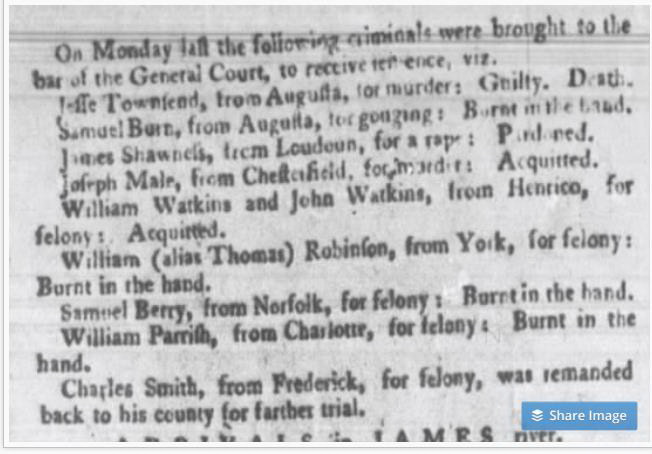
Then, James Shaughness gets pardoned
From the Executive Journals of the Council of Colonial Virginia, v.6 1754-1773, page 376 and page 377. The Council met on 6 November, 1770. They discuss the death of Botetort, talk about a Council President replacement, and also comment on possible pardons:
“Two of the Malefactors now under Sentence of Death, viz. William Gray, for Horse-Stealing, & James Shaughness, for a Rape, were recommended by the Board of his Honour, as fit Objects of Mercy.”
Of course, where is the “mercy” for Mary Hendrickson?? It’s a small wonder that the family left Loudoun during this time period and moved to Fayette County, Pennsylvania, and used the name Hendricks for many years in PA.
And remember, it was a pardon, not an exoneration. That means facts didn’t come to light later to show that Shaughness was innocent of the rape. He was found guilty in October 1770, and pardoned by the new Council President in November 1770, because it was a tradition.
There are only 3 reasons I can think of why he was pardoned
- There was a custom in the colonies at that time when a new governor took office, he pardoned the first case that came to trial. This case was probably the first capital punishment case to come to trial after Botetourt died on October 15, when Nelson became president of the Council, and before Dunmore took office a year later. This is probably the reason; see Executive Journal of the Council note at the bottom of this article. They chose between someone who stole horses and someone who had committed rape. (Seriously — this guy should get pardoned, not the guy who stole horses?)
- From the Loudoun court case, I got the impression that Shaughness was a convicted criminal transported from overseas. If this is true, he was probably an indentured convict servant. His master could have asked for the pardon so that he didn’t lose a valuable piece of property – his servant. This might have been a factor in Shaughness being pardoned. There is no mention of who his master was.
- Shaughness himself pleaded for his life. (Though, as an convict servant, I can’t imagine he any political power.)
Rape in Colonial Virginia
There is an article, The General Court of Colonial Virginia, it says there were ONLY EIGHT rape cases brought to court in Virginia in the 1700s. Five were aquitted, two were hanged, and one was pardoned – James Shaughness. I believe the author calculated that based on an analysis of court-related articles in the Virginia Gazette, and not from actual court records, so the number of rape cases could have been higher.
One of them is the case of Mary Hendrickson vs James Shaughness. Clearly there were more rape cases over the 130+ years of colonial rule in America, so women didn’t admit it or bring charges.
Women did not bring rape cases for a number of reasons: shame, guilt, fear, parental pressure. This case with Mary must have been dire, perhaps with pregnancy, beating or some other outward sign that people couldn’t ignore. Women had 40 days to bring the case forward; after that the court said “concealing it implies consent.” (By 40 days after a rape, a woman would know if she were pregnant.)
Since Shaughness was an indentured convict servant, even if he was pardoned, he might have been punished for the loss of work during his trial, and additional years added to his indenture. (Transported convicts were sold to plantation owners as a form of labor.) I can find no further information about him in the Loudoun records or in the Old Bailey (London) court cases, nor whom his master was in Loudoun. I can’t find him in USA records; he might have changed his name when he got out of jail, or went back to the UK.
If Mary had not told about the rape, and if she were pregnant, she could have been accused of “fornication,” which held a huge fine. Her father, John Hendrickson, would have been responsible for paying that fine. See the article, Enforced Bastardy by Roberta Estes for more information on indentured servants and pregnancy in this time frame.
So why did Mary Hendrickson report the rape?
(And does this help us to prove Naomi is the daughter from that rape? For those descendants of Naomi, it might be fruitful to look for Shaugness/Shawness/Shaughnessy DNA matches. Please let me know if you find any!)
We must remember this was a criminal course case, not a civil one. This case isn’t about establishing fatherhood or who is responsible for paying for an illegitimate child. But the civil case background might matter, and may have been the impetus for the government to file criminal charges. (I wish I had a copy of the original case file from Loudoun or the case file from Williamsburg, but I don’t. The Loudoun case file might still exist; the Williamsburg case file probably doesn’t exist…they lost many records during the Civil War. I’m looking into finding researchers in Loudoun who will find this case file for us if it still exists. Perhaps, one day, these files will be digitized and available online! Fingers crossed.)
I’ve been pondering this, and I have these two possibilities: either she was pregnant, or she was not pregnant but the situation was clear to outsiders and couldn’t be ignored. Here are three possible scenarios:
- This is a highly religious and puritanical era; if Mary is pregnant and it’s not rape, she would have been accused of fornication and her father would have had to pay a huge fine (upwards of 500 pounds of tobacco). Mary would have been stigmatized either way. In her situation, the shame of being raped would have been massive, and I’m guessing she would have avoided a public court case if she could. So if she’s clearly pregnant (or just gave birth), the government and church want to know what happened. She tells them she was raped, the criminal case begins. She would have had to be showing her pregnancy by July 1770, so she might have been many months pregnant or perhaps already had the baby. There are many known cases where, during the labor and delivery of a bastard child, the mother (when she is at her weakest and most vulnerable) is grilled by the midwives about who the father is. It’s possible that during her labor, Mary confessed that the father was Shaughness and that she was raped.
- Mary is or is not pregnant, and there were witnesses to the rape.
- Mary is or is not pregnant, and she was so badly beaten or mentally unstable that neighbors noticed and reported it.
Given the time frame of 1770, these are the only reasons I can think of why she would come forward. My best guess is that it’s reason #1 and that Naomi, born 1761-1770, is the child of that rape. Mary doesn’t marry until after 1794 when she’s 40 years old.
This is a heartbreaking story and one that needs to be told.

 Kinfolk Journal