
Besides the records you can find within paid sites like Ancestry.com, or MyHeritage.com, or free sites like FamilySearch.org, , there are additional places to find information on your early ancestors from New Jersey – for free!
In this example, I’m trying to find Dr. William Kimble. He should be in New Jersey by 1750 and was born in England, per his son Garret’s biography and 1880 census record.
A Few Notes to Make Your Life Easier
- As always, people weren’t perfect with spelling. I’ll try Kimble, KEmple, Kimball, and Kimpel, as I’ve seen records using those spellings. I’ll also use wildcards: K*M*B*L* and K*M*L*. William Kimble married Elizabeth Cole, daughter of Leonard Cole, and I’ve seen his name spelled Lennart Cole.
- Same name, same location, different families. Yes, it happens: two or more families in the same place at the same time, but NOT related to each other. In William Kimble’s case, he’s got two of them:
- Peter Kemble Sr of Mount Kemble is in the Morristown, NJ area. He does have a son William — who was in the British Army during the Revolutionary War and died in England. He’s not Dr. William Kimble and likely not his father, either (there are a ton of William Kimble and Kemble people in England where Dr. Kimble was born).
- Dr. William Kimble marries Elizabeth Cole. Her father is an original immigrant from Holland. But there is also a Cool/Kool family in the area who has been there for a much longer time — and some if their kids change the spelling to COLE. Alas, there are two Leonard Cole people in the area, one in Walpack, Sussex, NJ (from the Kool/Cool family) and one in Morris County.
- Two men, same name, same location, NOT father and son. The terms “Sr” and “Jr” typically mean father and son. But in many records, Sr is simply the older of the two men with the same name, and they’re likely Uncle and Nephew. If the dates don’t fit for a father/son relationship, try other relationship structure.
- Borders change. Counties are created. Townships like Pompton Township in Bergen County, NJ become defunct. Sometimes township lose part of their land when a new township or county is created. KNOW the history of when counties and township were created so you know where your ancestor might show up. They didn’t move — the borders moved around them. The Library of Congress has old maps of each county, and sometimes has the land owners listed on them. Here’s a map of where Pompton Township used to be.
- When someone says they’re born in a specific town, they might mean they were born NEAR that town or they might mean they were born in that township. For instance, Peter Kimble in his Revolutionary War application says he was born in September 1750 in “Rockaway, Morris, NJ.” But Rockaway TOWNSHIP wasn’t created until 1844 (Peter was dead by then) from Hanover and Pequannock townships. So, I’ll look in Hanover and Pequannock for his father.
- If you know anything about the family your ancestor married INTO, try to find their records first if you’re struggling to find your ancestor. People often married neighbors (but not always…sometimes they marry someone from quite a distance away, even before the Revolutionary War, because of other family ties). William Kimble married Elizabeth Cole, daughter of Leonard Cole. So I can look to see where Leonard or his sons are living around the time William and Elizabeth would marry (about 1782).
- Always look for an index in the back of the book. Sometimes when you find a book online as a PDF, it’s not indexed for digital searching. But they often have printed indexes in the back — they way you searched a book in the olden days! This will help you discover different name spellings.
Archive.org – Your Best Friend
- Archive has scanned and indexed a wide range of County history books, genealogical family books, books about the founding of churches and membership records, marriages, will and estate books, etc.
- Simple go to Archive and type the person’s name you’re searching in quotation marks, then click the Search Text Contents radio button.
- As always, try different spellings.
- If you don’t find anything for the person you’re researching, try one of their kids or grandkids.
- If you know the name of a town, type that in, too.
- In this example, I couldn’t find anything new for Dr. William Kimble besides the books I already knew about, so I tried his son, Garret Kimble. Garret died in Hardyston Township, Sussex County, NJ. I didn’t find anything for Garret KImble, so I tried Garret KEmble, and found three books mentioning him and that his father was a doctor.

- ALWAYS check the date of the publication. Newer books often simply copy content from older books without checking for sources or proof. In this case, the Sparta Presbyterian Church book was written in 1887, the Hardyston Memorial book was written in 1888, and the Kemble/Kimble family book was written in 1992. I also know the Rockaway Records book was written in 1902. Garret Kimble died in Hardyston in 1884, so the earlier books written just a few years after his death are likely sourced from one on Garret’s children, and probably the most accurate.
- Very new books, like the 1992 one, might include research that wasn’t available back in 1887, such as internet-based records.
- A book after 2018 might include DNA information. Also search for a YNDA project for your family surname. YDNA is DNA passed exclusively from father to son. In the Dr. William Kimble example, a Kimble/Kemple YDNA project will tell you whether he’s connected at all the the Morristown NJ Peter Kemble family. Here’s the Kimble/Kemple project results. It doesn’t mention Peter Kemble at all, but there is a section for the descendants of Dr. William Kimble. It’s fairly similar to the grouping above it which includes Nathan Kimble born in Sussex County NJ, but the DNA isn’t a complete match and it’s likely they’re NOT from the same father. But an Aha Moment occurs! HARMON Kimble is in the same YDNA group — and that’s HERMAN Kimble who was living next to William Kimble earlier in Bergen County.
- https://www.familytreedna.com/public/Kimble?iframe=ydna-results-overview&srsltid=AfmBOoqp-3wwKfQ7AsZ7lREGu_MNzhG_T0nmNvSlTU7B2JCFKdPBgFOb
- Sometimes family members didn’t really know what happened to siblings who left the area. The information is vague: “two sons died in the Revolutionary War” and “a third son went to Virginia”. In this example, I couldn’t find ANY Kimble man who died in the Revolutionary War. But two who were born Morris County did head west: Jacob Kimble first went to Frederick, VA and then into Greene, PA and his brother Peter first went to Berkeley, WV and then into Greene, PA. Both Peter and Jacob have Revolutionary War pension applications that say they were born in Morris County, NJ between 1750-1758. The 1887/1888/1901 books didn’t know about Peter and Jacob — but the 1992 book clarifies it.
- Check to see which family line is highlighted in the book. For instance, Garret Kimble is highlighted in the Hardyston/Sparta books. Rockaway Records focuses on William, Garret and Abraham — but only takes Abraham’s line into further generations. That tells you who gave the information to the author.
Military Records
- Revolutionary War:
- Strkyer’s official list of NJ soldiers
- County history books which often list the names of soldiers from that county
- For instance, The History of Sussex and Warren Counties has a huge list of soldiers who served from Sussex County:
- https://archive.org/details/historyofsussexw00snel/page/68/mode/1up
- Valley Forge Muster Roll site has a database lookup to see if your ancestor was a Valley Forge
- RevWarApps is a website that abstracts Revolutionary War pension applications. It focus on southern USA records but sometimes you’ll get luck and find your NJ person
- Abstract of Revolutionary War Pensions book
- Revolutionary Census of New Jersey
- An index of early tax records, this might help you find where your ancestor was living during and right after the Revolutionary War. Then you can look up the specific tax PDF, see Taxes and Ratables section below.
- https://archive.org/details/revolutionarycen0000stry/page/n6/mode/1up
- 1791-1815
- The 1791 era included two sets of troops: those who go on an excursion against the Indians and in 1794 those who go to western Pennsylvania to handle the Pennsylvania Insurrection aka the Whisky Rebellion
- 1812-1815 records include the War of 1812
- There’s a free book where they’re listed
- https://archive.org/details/cu31924032760211/page/n6/mode/1up
- Fold3 and Ancestry have similar records, but handwritten, and includes age, birth location, enlistment location.
- 1793 Militia Lists
- In 1793, the entire State of New Jersey took a special census of men between the ages of 18-50 who were eligible to be called up for militia duty. (Men born 1743-1775).
- You can download the PDF index in FamilySearch:
- This militia list would include some of the older men who served in the Revolutionary War and possibly the 1790s wars.
- This is your first opportunity to find men aged 18-21. At age 21, they’ll begin to appear on tax lists, so if they’re on a tax list but NOT this militia census, it gives you a good sense of their birth year
- If a man is NOT listed in this militia census but you know he’s still alive, he’s born BEFORE 1743 and too old to be on the list.
- MOST counties are included, but I have noticed Morris County’s list is incomplete. You can see the list here:
Land Records
- Older land records are available in three places
- New Jersey Searchable Databases
- Use % as the wildcard, not *. For instance, K%M%B%L%
- This site also includes older marriage records, NJ Supreme Court case records, Revolutionary War damage claim records, etc. It’s a treasure trove!!
- https://wwwdnet-dos.nj.gov/DOS_ArchivesDBPortal/index.aspx
- NJ Patents and Deeds 1664-1703
- Includes both East Jersey and West Jersey, most of these records abstracted an indexed in the New Jersey Searchable Database, but includes more details in this book.
- Has an index in the back
- https://archive.org/details/calendarofrecord21newj/page/n10/mode/1up
- To understand the border between East Jersey and West Jersey:
- Bureau of Land Management – BLM GLO
- If an ancestor got bounty land from war service, search anywhere in the USA and in the Militia box enter the full name of the State you think they served from. Don’t use abbreviations like NJ
- New Jersey Searchable Databases
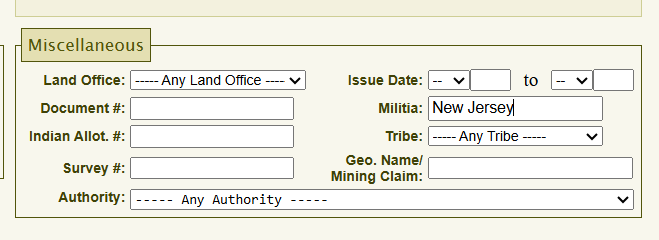
- If an ancestor got a Federal land grant, you’ll fin the record plus an image of the land grant. Note where they lived when they got the land grant — it might indicate which county or State they’re moving FROM when moving to the new land.
- FamilySearch.org has many land records, and you can either find them in the Grantor/Grantee index or by using their full text search feature for earlier land records.
- Sometimes a land deed does not get recorded until MANY years later when a child or grandchild sells the land.
- You can find out when your ancestor bought/sold land. Using FamilySearch’s full text search, you can see when your ancestor was mentioned in other people’s land records, either as an adjoining land owner or witness to a deed.
- If the land record is an estate division, you’ll see their siblings and/or spouses in the land records, too. Full text search on FamilySearch is a great way to find these records when you only know one sibling’s name. Remember to try married names for women.
- If you’re using full text search, try two methods:
- Use the full name with variations in quotes: “William Kimble” “William Kemble” “WM Kimble” (They often abbreviate names: Wm for William, Thos for Thomas, Jno for John or Jonathan, etc.)
- A quick note: JOHN and JONATHAN are two separate names. I’ve seen families where one son is called John and another is called Jonathan.
- Use wild cards: K*M*B*L* or if they used a P, just use this: K*M*L*
- You can access FamilySearch’s full text site here:
- https://www.familysearch.org/en/search/full-text
Tax Records aka Ratables
- The State of NJ has most of the available early tax records as PDFs on their website. These pages are all handwritten.
- These tax records begin during the Revolutionary War, but not before. Typically they begin 1776-1778.
- Sometimes the list is alphabetical by Last name
- Sometimes the list is alphabetical by FIRST name and then Last name (what were they thinking?)
- Sometimes the list is by “visitation” order and you can find who the neighbors are. The tax collector simply walked down the road and noted people as he came to the next house. For instance, William Kimble shows up in 1802 with a HERMAN Kimble living next door. But Herman (Harmon) appears to be too old to be William’s son, so is he a brother? We wouldn’t even know of the connection without the 1802 tax list.
- Sometimes there are TWO pages per image; make sure you check both sides of the image.
- Sometimes MORE names are listed at the end of the documents and/or Single Men have their own list at the end.
- In this example, neither William Kimble nor Leonard Cole are on the 1778 tax list for Hanover. But Rockaway was created out of both Hanover and Pequannock. When I look on the Pequannock 1778 tax list, I find Frederick Cole, but not Leonard Cole and not William Kimble. But I do see in Pequannock the Davenport family — some of them move to Saddle River, Bergen, NJ where I find William Kimble in 1782.
- Typically, men over 21 and men who owned property were taxed. Some jurisdictions had exemptions for men over 60, so if your ancestor is not listed, it doesn’t mean he’s dead.
- Most tax lists indicate whether they owned farm land or unimproved land, and how many acres.
- It’s possible they didn’t own the land – they might have been leasing it.
- It’s possible it was investment land and they didn’t live on it. Check to see if it’s improved farm land or unimproved land (two separate columns).
- Check to see if the Single Men column is checked (if not, they’re married)
- Check to see if the Householder or HH column is checked: they have a house on the property that they own (this might be a hint if the land is simple investment land). For instance, William Kimble has 70 acres of unimproved land and he’s neither single nor HH. This would make sense: William Kimble is a doctor, not a farmer. He’s probably renting a house, not building a farm house. But he’s married (the Single Man column is NOT checked). The 70 acres is probably investment land — and then I can look for when he sells that land or who is living on it later, like a son.
- Here is a list of all they have, with a link to the PDF
- Google and AI can be your friend when trying to find someone. Instead of searching page by page through all the PDFs, use Google to find people. Google’s AI has read these handwritten pages and indexed them in the Google Search results.
- To find these tax records using Google:
- In the search box type the SITE: command followed immediately by the URL of the tax list folder on the NJ.gov site, then a space and then the name you’re looking for. Do the same with each spelling variation and abbreviations like Wm or Thos
- You can also add a date like “1778” if you think your ancestor is in a certain place at a certain time.

- When I do this with “Kemble” I find William KEmble is already in Saddle River, Bergen, NJ in 1778 and that’s why he’s not showing up on the Morris County tax lists. And Abraham Cole, son of Leonard Cole, is on the same list, along with the Morris County Davenport men — all neighbors because this tax list is in visitation order
- William own no land, but he is Head of Household (HH) and married
- https://www.nj.gov/state/darm/WebCatalogPDF/SAS00001_Tax_Ratables/Bergen_County/Book129_BergenSaddleRiverTownship1778.pdf
Wills and Estate Records for New Jersey
This is a great resource, not only to look for wills and estate for your ancestors, but also to find them as witnesses to other people’s wills or mentioned as owning adjoining land.
Notes:
- The person’s individual estate record is listed by Last Name then First Name, so when searching, use quotation marks, like “Kimble, Peter”
- But search the entire book for the surname so you can find all instances of that family
- All have indexes in the back of the book (PDF) and this will help you find different name spellings within that book
- Volume 1 – 1670-1730
- Volume 2 – 1730-1750
- Volume 3 – 1751-1760
- Volume 4 – 1761-1770
- Volume 5 – 1771-1780
- Volume 6 – 1781-1785
- Volume 7 – 1786-1790
- Volume 8 – 1791-1795
- Volume 9 – 1796-1800
- Volume 10 – 1801-1805
- Volume 11 – 1806-1809
- Volume 12 – 1810-1813
- Volume 13 – 1814-1817

 Kinfolk Journal